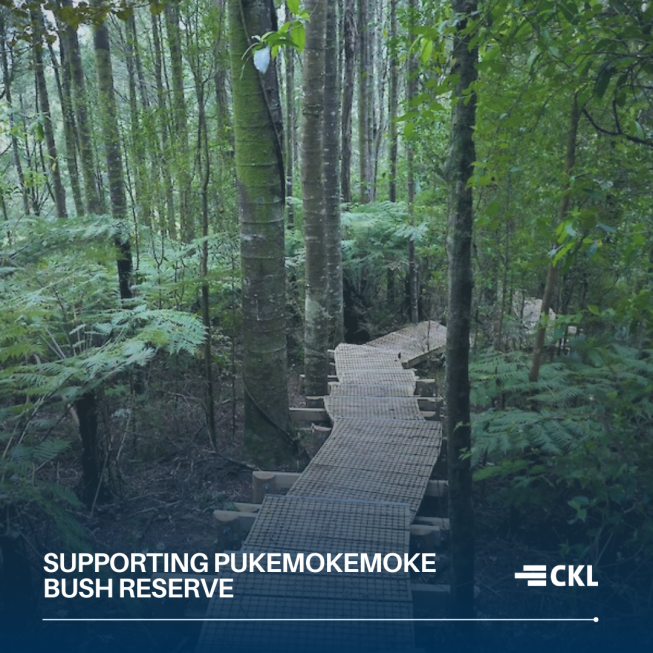
Just 30 kilometres north of Hamilton, Pukemokemoke Bush Reserve is a 40-hectare native forest remnant that feels worlds away from the city. Managed by the David Johnstone Pukemokemoke Bush Trust, the reserve includes a summit loop track, a raised boardwalk through a kauri grove, and a picnic clearing at the historic log hauler site. From the top, walkers are rewarded with sweeping views towards Mt Te Aroha, Mt Pirongia and the Hakarimata Range.
For decades, volunteers and Trustees have worked to restore and protect the bush. The reserve contains more than 300 native tree species and around 80 fern species, alongside birdlife such as tūī, kererū and pīwakawaka. Ongoing pest control, planting and track maintenance are largely community-led efforts.
As visitor numbers have grown, particularly with school groups and guided walks, safe and practical access has become increasingly important.
That’s where CKL became involved.
A two-stage solution to support safer access
Over the past three years, CKL has supported two related boundary adjustment surveys at the entrance to the reserve.
As use of the reserve increased, it became clear that the existing carpark required expansion to accommodate more vehicles and provide safer turning, including improved space for buses.
The solution was delivered in two stages.
The first survey enabled the legal boundary to be widened on one side of the entrance, allowing the physical footprint of the carpark to be expanded. With support from local suppliers and volunteers, the space was reshaped to improve circulation and safety.
The second survey widened the boundary on the opposite side, completing the adjustment and ensuring the expanded carpark and driveway area were fully aligned with the legal title.
Together, the two stages created a practical, long-term solution that supports growing visitor numbers while giving the Trust greater certainty around access and land tenure.
Late last year, following plan deposit, updated titles were issued reflecting the adjusted boundaries.
A practical, community-focused approach
CKL provided planning and surveying services across both stages of the project. Some components were delivered as part of a standard engagement, while other aspects were supported through donated professional time.
For CKL’s Survey Manager, Adam Musa, who was closely involved in both surveys, the decision to contribute was straightforward.
“It’s a fantastic regional resource. A lot of kids come out there for environmental days and school trips, and it’s such an accessible walk for families. It was really about making sure the access worked properly and was secure for the long term,” says Adam.
The planning process was pragmatic and collaborative. Waikato District Council recognised that the changes were focused on improving safety and aligning legal boundaries with the expanded carpark footprint, rather than introducing new built form into a sensitive ecological environment.
Protecting what makes it special
While a carpark might seem minor compared to the forest itself, access infrastructure plays a critical role in protecting sensitive environments.
Clear circulation, defined parking areas and safe bus turning spaces reduce informal parking or encroachment into bush margins. Formalised and widened boundaries also provide long-term certainty for the Trust and the community.
Over time, practical improvements like these make a meaningful difference. School groups can visit more easily. Buses can turn safely. The Trust can plan with confidence.
Projects like Pukemokemoke Bush Reserve reflect an important part of CKL’s work in supporting community assets alongside commercial and residential developments.
Planning and surveying expertise is often associated with growth projects, but the same skills can also help protect and future-proof places that already hold environmental and cultural value.
In this case, two carefully staged surveys and a collaborative approach have helped secure long-term public access to one of Waikato’s special natural areas.