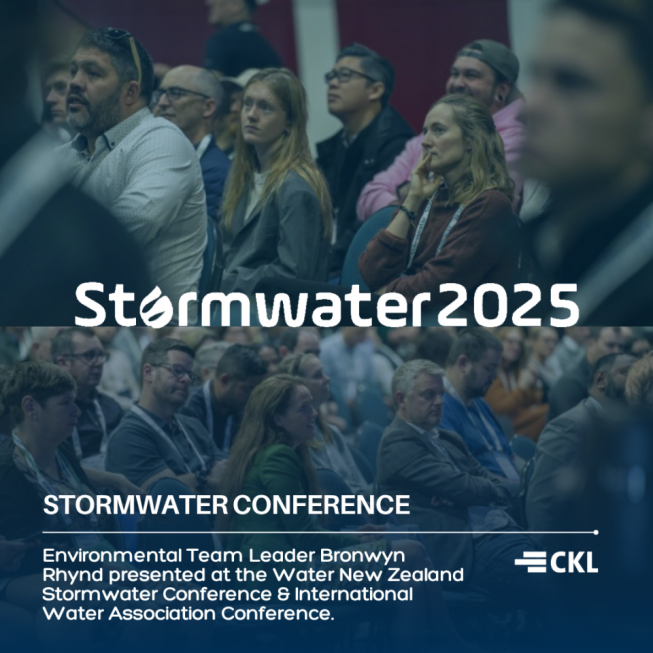

At the recent Water New Zealand Stormwater Conference & International Water Association Conference, CKL’s Environmental Team Leader, Bronwyn Rhynd, presented on one of the most significant freshwater challenges in Central Otago: restoring the health of Lake Hayes (Wai Whakaata).
A lake under pressure
Lake Hayes is a nationally and regionally significant natural feature, but over decades, land use change and sedimentation have contributed to a decline in water quality. Sediment loading has tipped the lake into periods of poor health, increasing nutrient availability and fuelling algal blooms. The clear message from countless technical studies has been: fix the catchment, and you will fix the lake.
An opportunity through Ayrburn
The Ayrburn development, located upstream of Lake Hayes, presented a unique opportunity. Working alongside developer Winton and the community group Friends of Lake Hayes, CKL was tasked with integrating stormwater management into the landscape design. Rather than simply meeting compliance standards, the project set out to achieve measurable betterment of water quality.
The site includes:
- The operational Ayrburn hospitality precinct, set within repurposed heritage buildings.
- The Northbrook retirement village, under construction.
- A proposed Screen Hub film studio, currently lodged under the Fast Track process.
Nature-based stormwater solutions
The project employs a treatment train approach, layering multiple stormwater measures to build resilience and ensure consistently high-quality outcomes. This includes:
- Raingardens and bioretention ponds to filter runoff from hard surfaces.
- Engineered wetlands that use vegetation to remove sediment and absorb nutrients.
- Swales and detention ponds to slow water and promote natural infiltration.
- Sediment retention ponds placed within Mill Creek to capture existing sediment before it reaches Lake Hayes.
- Riparian planting and rock armouring to stabilise creek banks and provide habitat for native species.
Monitoring and measurable results
Continuous monitoring has been critical. NIWA-managed data loggers have recorded turbidity upstream and downstream of the site every five minutes since 2019. The data shows a consistent trend of improvement:
- In 2019, turbidity was better downstream only 38% of the time.
- By 2024, this had improved to 77%.
- 91–95% reduction in total suspended solids (TSS)
- 77–82% reduction in heavy metals (zinc, copper)
- At least 50% reduction in nitrogen and phosphorus
A benchmark for future development
Bronwyn’s presentation emphasised that stormwater doesn’t need to be treated as a “tick box” compliance requirement. When integrated with landscape design, it becomes an opportunity to deliver environmental enhancement, community amenity, and long-term resilience.
The Ayrburn project demonstrates how collaborative, nature-based design can transform development into a tool for environmental betterment, setting a benchmark for future projects across New Zealand.